Karnataka Continues Its Dominance in Indian Swimming
Karnataka swept 40 gold, 22 silver and 18 bronze at the 52nd Junior National Aquatics Championships in Bhubaneswar — more than double Maharashtra's gold count, and ten times Tamil Nadu's.
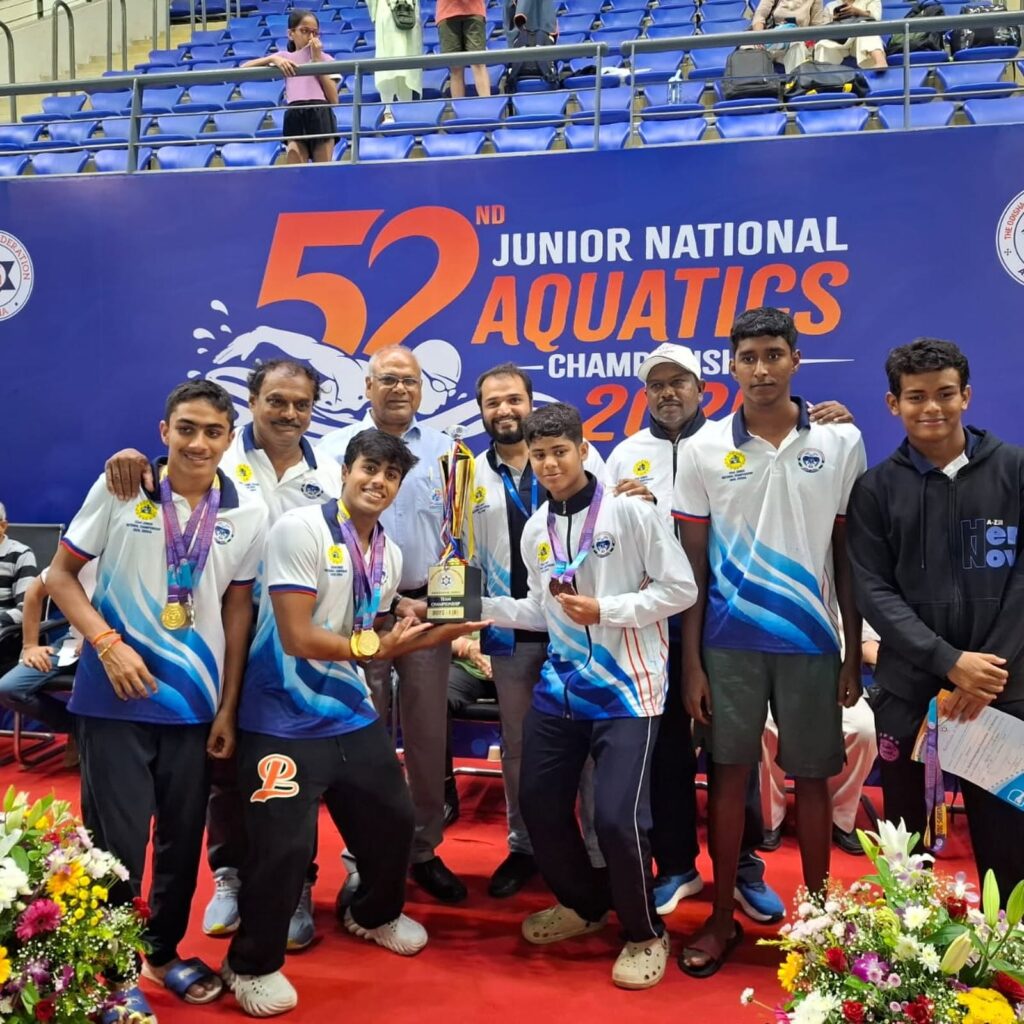
Karnataka’s dominance of Indian junior swimming shows no signs of slowing. At the 52nd Junior National Aquatics Championships in Bhubaneswar, the state swept 40 gold, 22 silver and 18 bronze — more than double Maharashtra’s gold count, and ten times Tamil Nadu’s.
Karnataka’s overall championship points total, 624, and team titles in Boys I(A), Boys I(B), and Girls I(A) — Maharashtra took only Girls I(B) — round out a picture of dominance that spans nearly every age bracket and stroke.
Not a one-off
This is not a new story for Karnataka. At the 51st Junior Nationals in Ahmedabad last year, the state topped the medal table with 37 gold, 26 silver and 23 bronze — 86 medals — and won three of the four team titles on offer (Boys I, Boys II, Girls I), ceding only Girls II to Maharashtra, exactly as this year. A year before that, at the 50th Junior Championships — run as a combined Sub-Junior and Junior meet in Bhubaneswar — Karnataka’s overall points total was 799, against a bundled medal count of 50 gold, 24 silver and 30 bronze. That figure spans both Sub-Junior and Junior swimmers together, not the Junior category alone, so it isn’t a clean line to draw against 2025 or 2026’s Junior-only numbers — a pinch of salt worth keeping in view. Even so, the shape across three championships holds: Karnataka has now taken the Junior overall title, and every team championship but the Girls I(B)/II bracket, at every meet on record.
By the numbers: the top 10
Source: Swimming Federation of India, Medal Statistics — 52nd Junior National Aquatics Championships 2026, Bhubaneswar. Top 10 states shown.
| Rank | State | Gold | Silver | Bronze | Total |
|---|---|---|---|---|---|
| 1 | Karnataka | 40 | 22 | 18 | 80 |
| 2 | Maharashtra | 16 | 18 | 24 | 58 |
| 3 | SSCB | 5 | 6 | 1 | 12 |
| 4 | Tamil Nadu | 4 | 15 | 14 | 33 |
| 5 | Assam | 4 | 3 | 2 | 9 |
| 6 | Gujarat | 4 | 2 | 4 | 10 |
| 7 | Telangana | 3 | 1 | 4 | 8 |
| 8 | Manipur | 2 | 1 | 0 | 3 |
| 9 | Uttar Pradesh | 1 | 2 | 1 | 4 |
| 10 | Rajasthan | 1 | 0 | 1 | 2 |
The spread, not just the score
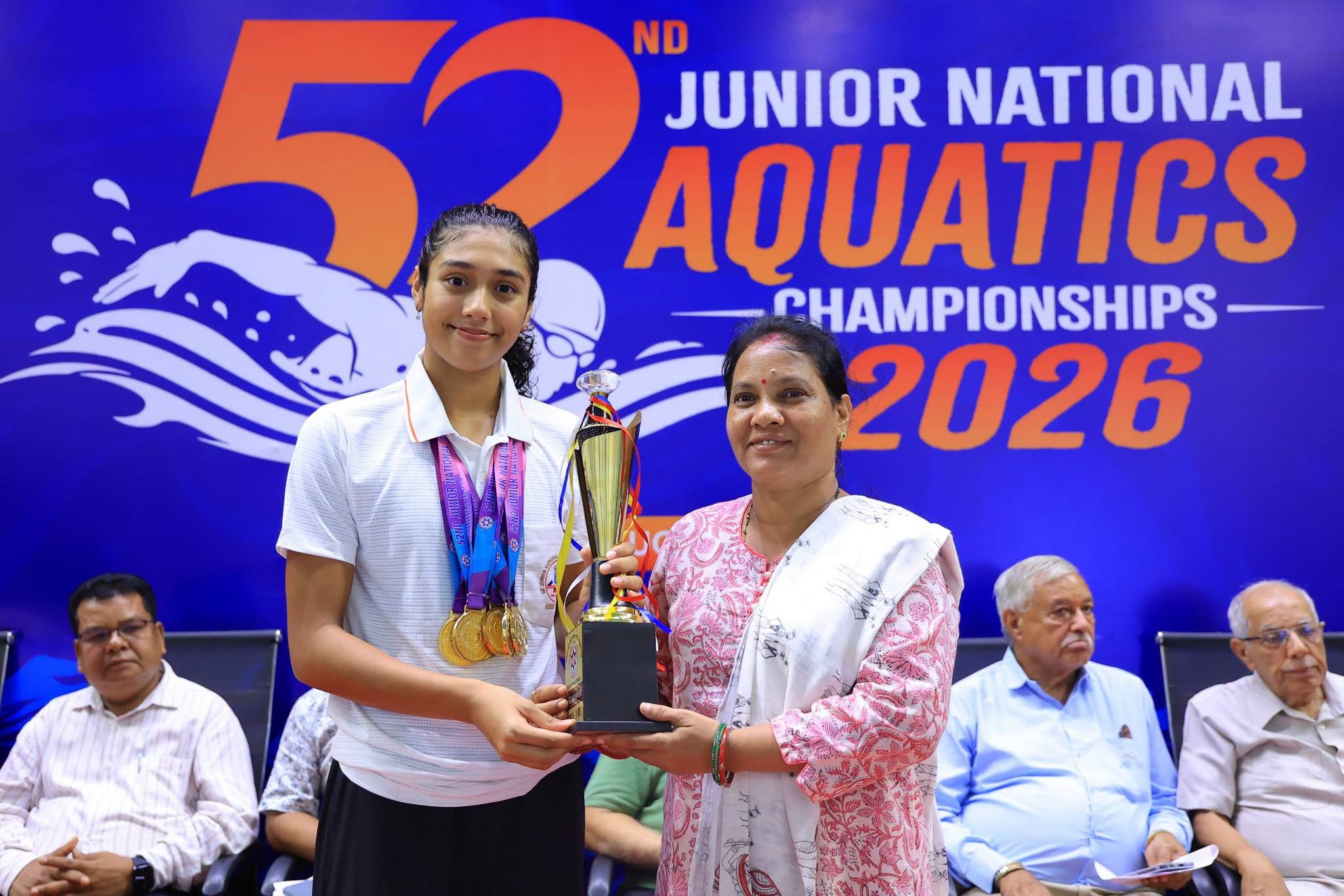
What separates Karnataka’s showing from a typical medal-table headline is where the golds came from. SFI’s own “Best Swimmer” citations for the meet single out two Karnataka swimmers: Sharan S, born 2011, who collected 5 golds in the younger I(B) bracket — sweeping freestyle from 100m to 1500m against boys up to two years his senior. On the girls’ side, Sri Charani Tumu took 4 golds in the I(A) bracket. Add Daniel Paul J’s breaststroke wins, Vedanta Venkata Madhira and mongam theerdhu samadev’s backstroke podiums, and Tanishi Gupta’s four-gold haul in I(B), and the pattern holds: no single swimmer carries the tally the way Saanvi Deshwal (5 golds) carries Maharashtra’s.
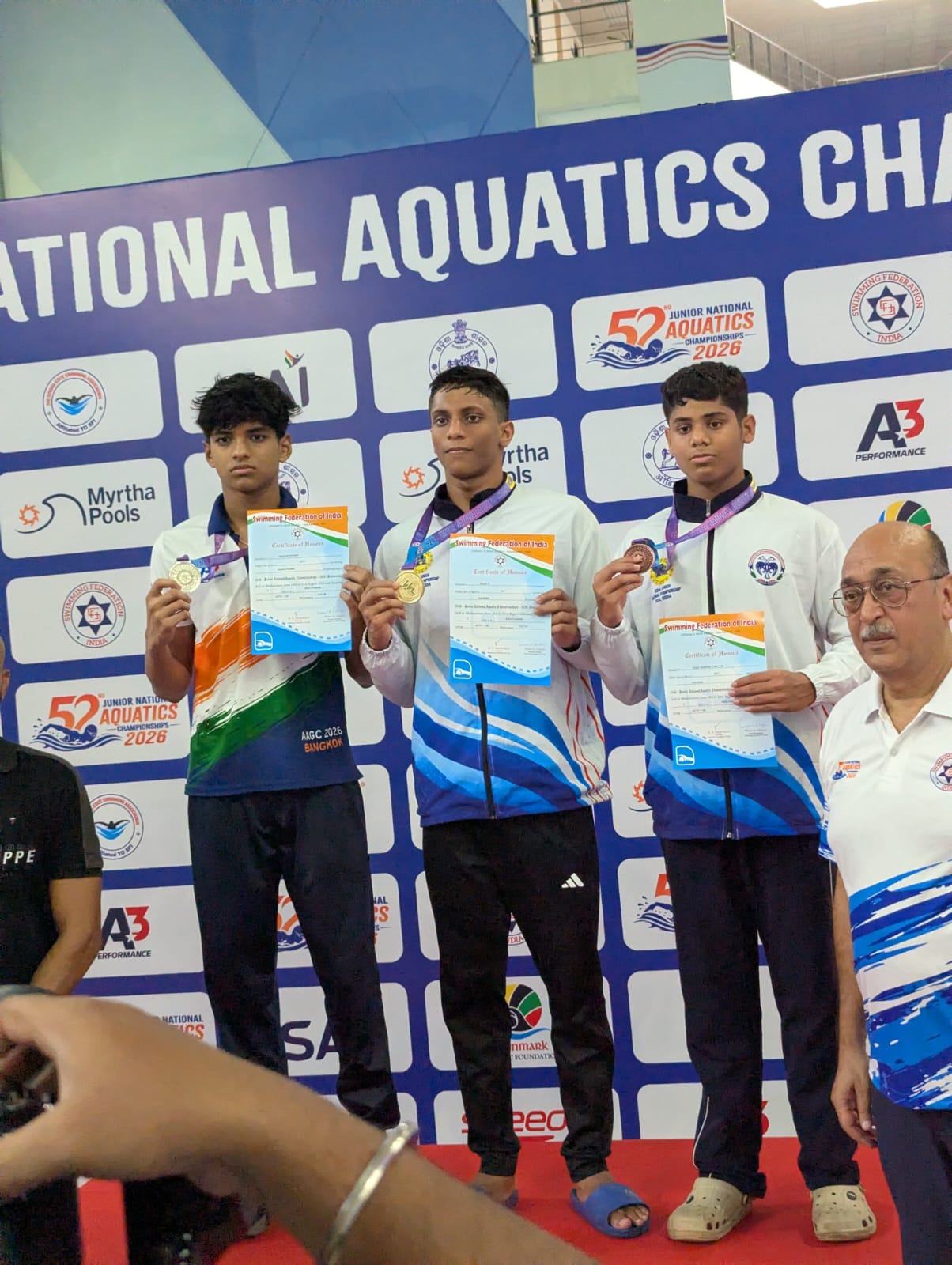
Not every Karnataka result was gold, either — 2011-born Vihaan Shashwat Chaturvedi took bronze in both the 200m Backstroke and 800m Free I(B) finals, the youngest swimmer on the podium in fields otherwise made up of 2010-borns, a small footnote to the same depth story.
Depth vs. star power
Take Saanvi Deshwal out of Maharashtra’s tally and their gold count collapses to single digits. Karnataka’s total doesn’t depend on any one name the same way — which is the more interesting story than a medal count on its own: a state producing winners across nine or ten different individual events, across two age bands, points to a system — feeder clubs, coaching pipelines, selection depth — that other state associations will need to reckon with as this cohort moves toward seniors. Karnataka’s dominance isn’t purely a home-turf story, either: a fair number of medallists swimming under other state flags in this age group train year-round at one of Bangalore’s numerous swim academies, which complicates any simple state-vs-state reading of the table — the city’s coaching infrastructure is arguably shaping this result as much as any one state association is.
That kind of across-the-board depth is exactly what the SFI’s newly restructured National Talent Pool Development Program is built to reward. As we reported when the 2026 age-band and NTPD revisions landed, the federation tightened its qualifying time standards hardest in the 13–15 window — precisely the range Karnataka’s Sub-Junior and early-Junior swimmers are moving through right now — while shifting the youngest tier’s criteria from results-led to attributes-led. A state producing this many finalists across this many events isn’t just winning medals under the old system; it’s the one best positioned to feed swimmers into the new one.
The broader picture: what Jaipur says about the pipeline
Zoom out one age category and the picture gets more interesting. The 42nd Sub-Junior National Aquatic Championships — a distinct, younger category (Groups II and III, roughly ages 11–14) held separately in Jaipur, 6–9 August 2026, and not directly comparable to the Junior results above — also crowned Karnataka overall champion, on 310 points, with team titles in Boys II, Boys III and Girls II. But the gold column tells a different story: Tamil Nadu, not Karnataka, topped the Sub-Junior gold count, 13 to 10, even as Karnataka’s 39 total medals comfortably outpaced Tamil Nadu’s 28.
Source: Swimming Federation of India, Medal Statistics — 42nd Sub-Junior National Aquatic Championships 2026, Jaipur. Top 10 states shown.
| Rank | State | Gold | Silver | Bronze | Total |
|---|---|---|---|---|---|
| 1 | Tamil Nadu | 13 | 13 | 2 | 28 |
| 2 | Karnataka | 10 | 10 | 19 | 39 |
| 3 | Bengal | 6 | 2 | 3 | 11 |
| 4 | SSCB | 5 | 0 | 1 | 6 |
| 5 | Delhi | 4 | 1 | 3 | 8 |
| 6 | Assam | 3 | 0 | 2 | 5 |
| 7 | Odisha | 3 | 0 | 0 | 3 |
| 8 | Maharashtra | 2 | 7 | 3 | 12 |
| 9 | Madhya Pradesh | 2 | 1 | 2 | 5 |
| 10 | Manipur | 1 | 8 | 3 | 12 |
Karnataka’s Sub-Junior medal composition — 10 gold, 10 silver, but a bronze-heavy 19 — reads as depth without the same concentration of outright winners Tamil Nadu is producing at this younger level (Abdul Hafeez and Divashree Kesavan each took 5 golds for Tamil Nadu in the Boys/Girls II brackets, echoing exactly the “one or two stars carry the tally” pattern Karnataka avoids at Junior level). Whether that gold gap closes, holds, or grows by the time this cohort reaches Junior Nationals in two years is arguably the more consequential story for Karnataka’s swimming establishment than anything in this year’s Junior medal table — worth flagging now and revisiting at the 43rd Sub-Junior Championships.
Junior Watch: the names we’d already flagged
This result also gives us a chance to check our own homework. In “20 Under 20: Indian Swimming’s Next Generation” (18 May 2026) and “Top 20 Under 20: The Young Women Leading Indian Swimming’s Next Wave” (7 June 2026) — published months before this year’s Junior and Sub-Junior Championships — SwimmingDrive named the swimmers we thought would define the next cycle. A comfortable number of them showed up on the podium in Bhubaneswar and Jaipur exactly as flagged.
On the boys’ list: Sharan S (No. 19, tipped for “distance freestyle sweep at the 50th Junior Nationals”) went on to deliver the five-gold freestyle sweep at the heart of this piece. M. Abdul Hafeez (No. 20, flagged as the youngest name on the list, “racing age groups above his own”) took five golds and the Best Swimmer II title at the Sub-Junior Championships in Jaipur. Laitonjam Lanchenba (No. 18, already credited with three Junior National golds in butterfly) held onto the event in 2026. Among the “knocking at the door” names in that same piece, Vihaan Chaturvedi, Vedanta Venkata Madhira, Yash H Pal, Samarth Gowda B S and Atharvraj Sayaji Patil all medalled this year — Madhira and Yash Pal with golds (200m Backstroke I(A) and 200m Breaststroke I(B) respectively), Samarth Gowda with a 100m Backstroke gold, Chaturvedi with the two bronzes noted above. Daniel Paul J and M. S. Nitheesh, both flagged as stroke specialists, both won gold again in their specialities — breaststroke for both.
On the women’s side, Saanvi Deshwal (No. 6) and Sri Charani Tumu (No. 18) both went on to Best Swimmer titles this year, exactly as flagged. Tanishi Gupta (No. 4) took three individual golds in Bhubaneswar; Rujula S (No. 15) took two. Assam’s Subhranshini Priyadarshini, an honourable mention in June, backed that up with silver in both the 1500m and 400m Free at this year’s Championships.
Not every call needed a caveat, but one did: the women’s list had Dhinidhi Desinghu down as Tamil Nadu, against every SFI results sheet we’ve pulled for her — 2024’s Best Swimmer citation, this year’s Junior gold, the standing national records referenced in the Sub-Junior results book — all of which have her swimming for Karnataka. That’s now fixed on the live piece. Worth noting where she is right now, too: Dhinidhi is currently preparing for the Asian Games — the pipeline story this section keeps circling back to, playing out in real time.
More from Races & Results