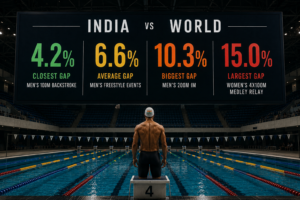
The Level Pool: Why Mandatory Trials Are the Ordinary Swimmer’s Best Protection
Indian competitive swimming has a class structure. The SFI mandatory trials rule is blunt and imperfect — but it is the ordinary swimmer's best guarantee that selection will require performance on equal ground, not just a fast time from a facility most Indian families will never see.
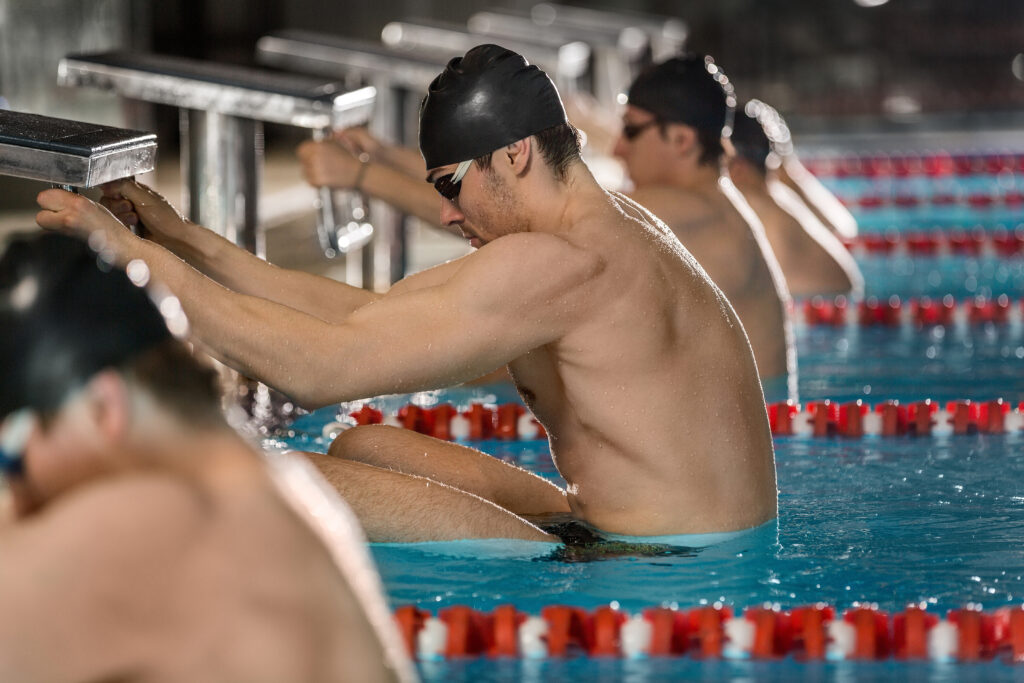
The meet is on, the heat-list was out the night before. It is a big qualification meet for the upcoming nationals. As the nervous swimmers take their stance on the diving blocks, a few lanes are empty — lane 3 and lane 5. Just as the others are about to heave a sigh of relief, an announcement is made: two swimmers will not be participating in the event, but they have submitted their qualifying times. So instead of competing against actual opponents, the swimmers in the water are left racing against times — from pools they have never seen, under conditions they can only imagine.
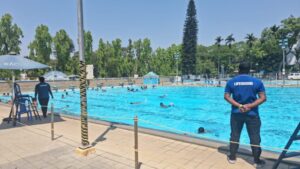
In all probability, the absent swimmers are training in a 50-metre, temperature-controlled pool abroad. Their strokes rebuilt by a foreign coach. They know their times will carry them through regional qualification — they are already preparing for the nationals and beyond. Meanwhile, the swimmers in the water have trained year-round in a 25-metre municipal pool with broken lane ropes, coached by someone who genuinely cares but has never attended a World Aquatics technical seminar. They do not have the latest suits or the best guidance — yet they are here, and they are trying.
Now, here is a question. Who has the fairer shot?
This is not a hypothetical scenario. Ask any family that has spent years navigating the domestic swimming circuit in India and they will recognise this scene immediately. The frustration is real, it is quiet, and there is very little they can do about it.
The Invisible Hierarchy
The harsh truth is that Indian competitive swimming has a class structure. It is not in your face, but it is there if you know where to look.
At the top of the pyramid sit the privately funded or government-sponsored elite — swimmers with access to foreign training, high-end equipment, and coaching infrastructure that simply does not exist in most Indian cities. Beneath them are the resourced domestic swimmers, usually from metropolitan clubs with decent facilities and coaching networks. And then there is everyone else: the majority, training hard in conditions that would make a foreign federation wince, competing on hope, talent, and whatever their families can stretch to.
The issue is not that elitism exists — every sport has its hierarchy. The problem is when the system quietly tilts the odds further in favour of those already at the top. And one of the most common ways that happens is through selection processes that value a declared time from an international race over a head-to-head race on home soil.
What a Time Cannot Tell You
There is a persistent argument, usually made by those who benefit from it, that a World Aquatics-sanctioned time clocked at an international meet should be sufficient for national team selection. Why force an athlete to travel back, disrupt training, and race domestically when the clock does not lie?
The clock does not lie. But the context around it does.
A time swum in a modern, 50-metre, deep-water competition pool in Europe or Australia — with optimal water temperature, world-class starting blocks, pacemakers, and perfectly calibrated timing systems — is not the same performance as a time swum at a domestic championship in India. It is not a question of rules or intent. It is physics, psychology, and the quiet accumulation of resource advantages. The overseas swimmer is not cheating. They are simply operating in a different universe and asking the rest of the field to pretend that universe does not exist.
When you allow selection by time alone, you are not rewarding the best swimmer. You are rewarding the swimmer who had access to the best conditions. That is a very different thing.
The One Rule That Equalises Everything
There is a mechanism — blunt, imperfect, and inconvenient — that addresses this directly. The Swimming Federation of India’s mandatory participation rule, which requires competitive swimmers to appear at the Senior National Aquatic Championships for selection consideration, matters far more to ordinary families than the debate around it suggests.
It has been criticised as inflexible. There are genuine conversations to be had about building exception frameworks for extreme circumstances — a swimmer genuinely competing at a World Championships qualifier on the same date deserves considered accommodation. But those are edge cases, and they should be treated as such: exceptions with clear criteria, not loopholes that quietly swallow the rule.
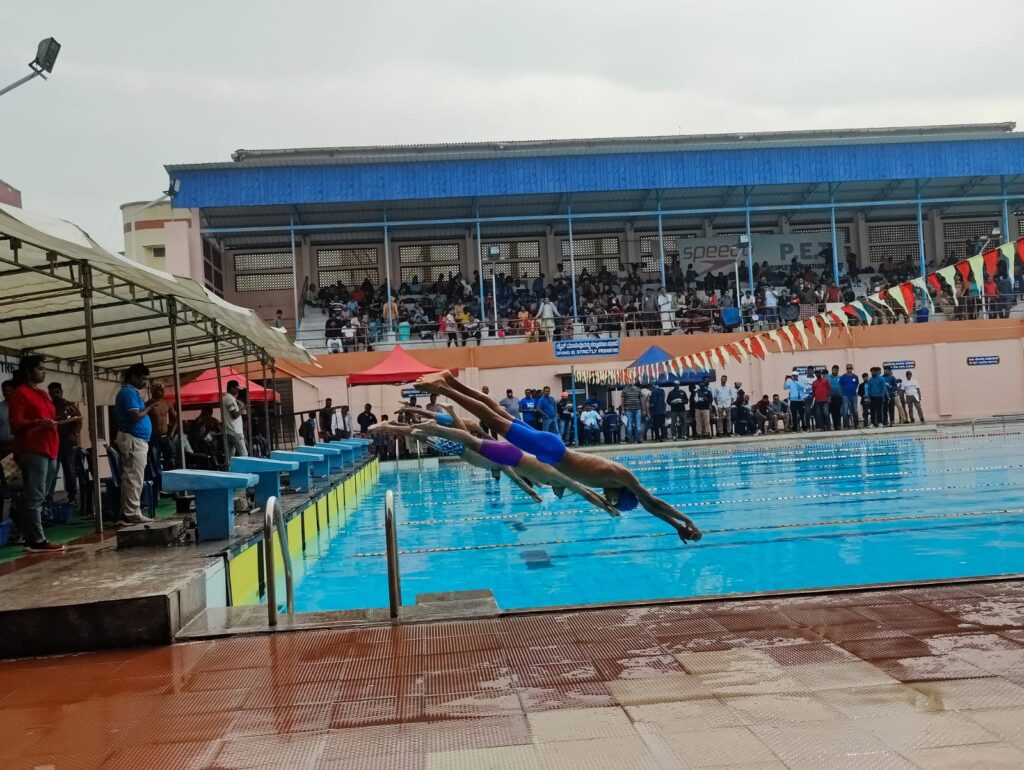
At its core, the mandatory trials rule does something no other mechanism in Indian swimming currently does: it puts every swimmer on the same blocks, in the same water, on the same day.
The wealthy swimmer who trained abroad still has advantages — better preparation, better conditioning, probably a better taper. Nobody is pretending those disappear at the starting block. But the gap between racing someone and being selected over someone who was never in the same pool is enormous. The mandatory trials rule closes that gap. It demands presence. It demands performance under the same conditions, against the same competition, in front of the same selectors. For the domestic swimmer from a Tier-2 city, that is not a small thing. That is the whole thing.
The Public Funding Argument Nobody Talks About Enough
Here is the part that deserves more scrutiny than it gets.
India’s top competitive swimmers are, overwhelmingly, not self-funded. A significant number receive direct support through the Target Olympic Podium Scheme — monthly stipends, elite coaching, and sponsored foreign training, all funded by the Indian taxpayer. Others are beneficiaries of the Khelo India scholarship framework. Many hold sports-quota positions in the Railways, Defence services, or state police, providing financial security that the average Indian family — including most swimming families — cannot access.
They are all deserving. They have earned that support. But public investment is not a gift. It is a contract. The expectation — even if never written this bluntly — is that athletes receiving public money perform their duties to the national sports ecosystem. Appearing at the Senior National Championships is the most basic of those duties.
When a publicly funded athlete treats the domestic championship as optional, the damage is not just symbolic. A fifteen-year-old swimmer from Nagpur or Bhubaneswar or Mangalore, competing at their first Senior Nationals, is not thinking about institutional equity frameworks. They are looking at the elite swimmers warming up in the next lane and recalibrating their own ceiling in real time. That recalibration — upward, always upward — is one of the most powerful and least measurable things a national championship can do for the future of the sport. Remove the elite from that equation, and you remove the aspiration.
The Level Pool
The mandatory trials rule exists to protect the many from the structural advantages of the few. It is the ordinary swimmer’s best — and often only — guarantee that selection will require performance on equal ground, not just a fast time from a facility most Indian families will never see.
India is not the United States or Australia. The infrastructure, the funding depth, the coaching ecosystem — none of it is comparable yet. Until it is, the norms and mechanisms must serve the large majority, not just the handful with access to the exceptions. As swimmers gather in Ahmedabad for the Senior Nationals, with Commonwealth Games selection on the line, there will be no back-door qualifications. Victory and defeat will be earned in the open, in the same water, on the same day.
The pool should be level. This rule, imperfect as it is, helps keep it that way.
Shashwat DC is a journalist with over 25 years of experience and the founder of SwimmingDrive.com. He is also a swimming parent and an independent observer of the Indian competitive swimming circuit.