The Blue Wave: Why Bengaluru is the Undisputed Swimming Mecca of India
The road to the top of Indian swimming passes through Bengaluru. Here is how the Garden City became the undisputed capital of Indian aquatics — through geography, institutional design, corporate gravity, and four decades of unbroken excellence.
One of the most striking facts about competitive swimming in India is this: the road to the top passes through Bengaluru. If you want to win laurels at the Junior or Senior National Aquatics Championships — or beyond — training in Karnataka’s capital is not an advantage. It is almost a prerequisite.
Today, Karnataka leads the medal tally at every major national competition. Maharashtra, West Bengal, and Kerala mount challenges, but none can dislodge the southern giant. The reason is straightforward: Bengaluru.
This did not happen by accident. The Silicon Valley of India became the swimming capital of India through a precise confluence of geography, institutional design, corporate investment, and cultural memory. Here is how the Garden City became the ultimate powerhouse of Indian aquatics.
The Genesis: When the Capital Moved South
For much of the 20th century, Indian swimming belonged to the East and the South-West. Sachin Nag — who won India’s first-ever Asian Games gold in the 100m freestyle in 1951 — hailed from West Bengal. Mihir Sen, the first Indian to swim the English Channel in 1958, built his aerobic base in the river systems of the East. Kerala dominated early long-distance events and water polo through its vast backwater network.
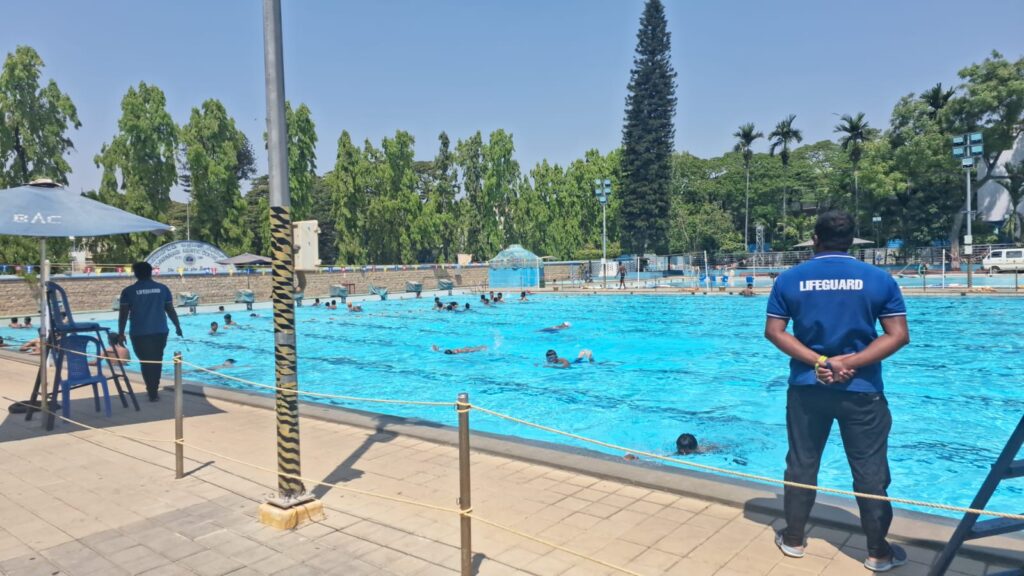
The first seismic shift came in 1986 with the founding of the Basavanagudi Aquatic Centre (BAC), driven by the vision of the late R. Neelakanta Rao Jagdale. The watershed moment followed in 1991, when the Bangalore City Corporation leased its Pampamahakavi Road public pool to BAC under a pioneering Public-Private Partnership model. Instead of decaying under bureaucratic indifference, the facility was run like a disciplined elite sports institute.
By the late 1990s, this club-centric model had triggered unprecedented dominance: Karnataka embarked on a historic streak of 34 consecutive State Team Championship titles. The names that emerged from BAC under renowned coach Pradeep Kumar read like a who’s who of Indian swimming — Nisha Millet (India’s sole swimmer at the 2000 Sydney Olympics), Rehan Poncha, Shikha Tandon, Sandeep Sejwal, and Sajan Prakash, the first Indian swimmer to achieve the Olympic ‘A’ qualification mark. The modern generation continued the lineage: Srihari Nataraj and Dhinidhi Desinghu both point back to Bengaluru as the crucible.
Worth noting: it is not only Karnataka-born swimmers who train here. Over the years, elite athletes from across India have relocated to Bengaluru’s pools — cementing its position not as a regional hub, but as a truly national one.
The Geographic Advantage
Bengaluru’s geography is a silent but powerful ally. Sitting at 920 metres above sea level on the Deccan Plateau, the city enjoys a climate that no other Indian metro can match for year-round athletic training.
Delhi’s winters force unheated 50-metre pools to shut for up to four months. Mumbai’s monsoons disrupt outdoor training cycles with brutal regularity. Bengaluru has neither problem. Its mild summers prevent pool temperatures from becoming energy-sapping, and its brief winters are managed through temperature-controlled systems at elite facilities. The result: uninterrupted, 12-month training calendars that compound advantage over rivals who lose a quarter of every year to weather.
An age-group swimmer in Bengaluru is rarely more than 20-30 minutes from elite coaching — BAC, Kensington Pool (Ulsoor), KC Reddy Pool (Sadashivanagar), Nettakallappa Aquatic Centre (NAC), and the SAI Regional Centre all run active long-course competitive programmes.
The Black Hole Effect: Why Rivals Joined Instead of Competing
In the mid-2010s, it appeared that corporate investment in Odisha and aggressive state sports policy in Maharashtra might finally decentralise Indian swimming. What followed instead was a lesson in ecosystem gravity.
Rather than pulling talent away from Karnataka, India’s largest sports institutions eventually moved their own operations there. JSW Group initially established its Odisha JSW Swimming High Performance Centre at Kalinga Stadium in Bhubaneswar with considerable fanfare. But to maximise high-performance output, JSW shifted its elite swimming engine to the Inspire Institute of Sport (IIS) in Vidyanagar, Karnataka — and brought in Olympian and Asian Games medallist Sandeep Sejwal to lead its technical coaching pathway. Sejwal himself had trained in Bengaluru under Dronacharya Awardee Nihar Ameen.
Even the Sports Authority of India, with infrastructure spanning Delhi to Gandhinagar, relies on its Bengaluru Regional Centre for its highest-tier national camps and TOPS athlete placements. SAI understands what the numbers confirm: national-level swimmers need to consistently compete against Karnataka’s dense domestic talent pool.
The Academic Safety Net: The Jain University Blueprint
The most consistent destroyer of Indian athletic careers is the drop-out crisis at 16 or 17 — the age when promising athletes abandon sport for board exams and university admissions. Bengaluru systematically dismantled this barrier.
Jain (Deemed-to-be University), led by London 2012 Olympian Gagan Ullalmath, transformed sport from extracurricular to institutional pillar. Through its integrated Sports School model, an elite swimmer can live, train six hours a day, and earn a respected university degree within a single high-performance environment.
The Full Ecosystem
Elite swimming demands more than pool time. Strength and conditioning, nutrition, physiotherapy, sports psychology, and data analytics all determine whether a talented swimmer becomes a champion or a cautionary tale. Bengaluru has assembled all of it.
The Unbroken Chain
Odisha, backed by heavy state funding, and Gujarat, with its state-of-the-art Sardar Patel Aquatic Complex, are mounting serious bids to replicate Bengaluru’s success. What they are discovering is that institutional memory cannot be purchased.
When a seven-year-old child dives into a pool in Basavanagudi or Yelahanka, they are sharing lanes with national record holders, training under coaches who have stood on Olympic decks, supported by corporate infrastructure, cushioned by sports-friendly universities, and calibrated by an ecosystem built over four decades.
That is Bengaluru’s true moat — not any single pool or coach or champion, but the unbroken chain connecting all of them. It is why Bengaluru remains, and will remain for the foreseeable future, the undisputed capital of Indian swimming.