Face Up, Eyes to the Sky: The Greatest Backstrokers and the Races That Defined Them
Seven decades of world records, seven swimmers who rewrote what the stroke could be, and races so extraordinary they changed the sport forever. This is backstroke - and finally, India has something to say.
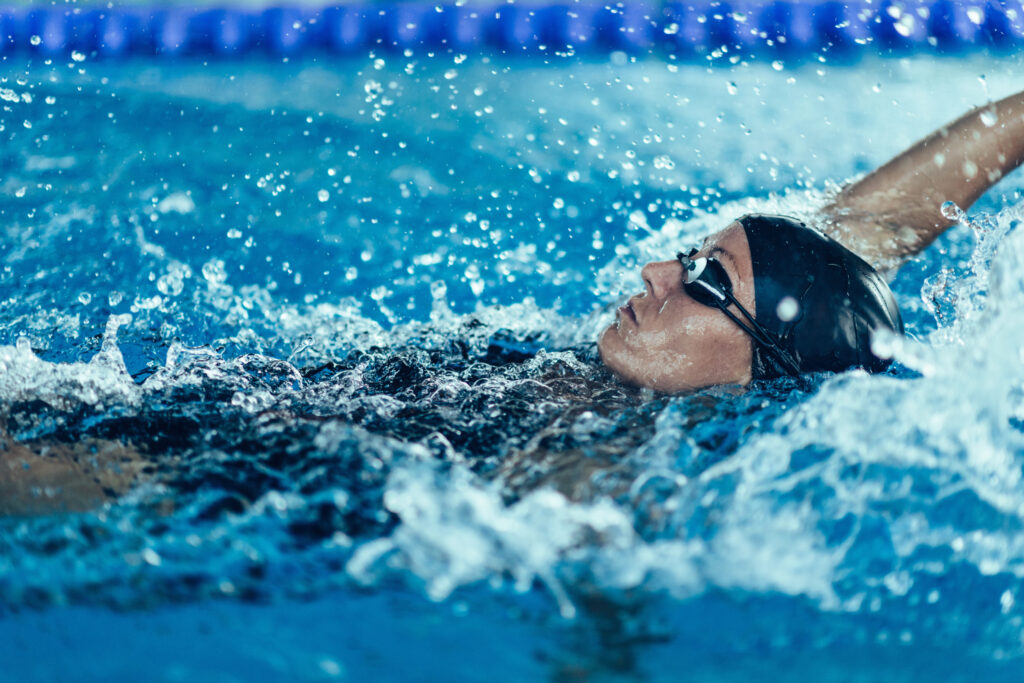
There is a particular loneliness to backstroke. Every other competitive swimmer in history has stared down at a black line on the pool floor, using it as a guide, a comfort, a fixed point in a world of effort and oxygen debt. The backstroker has none of that. You lie on your back, look up at the ceiling or the sky, count your strokes, read the flash of the lane rope at the edge of your vision, trust the flags hanging five metres from the wall and race. You cannot see where you are going. You learn to see with your body instead.
It is the oldest Olympic stroke after freestyle, making its debut at the 1900 Paris Games. It has produced some of the sport most dominant dynasties. And right now, in 2026, it is producing the greatest rivalry swimming has ever seen. And then there is India.
The Legends
Roland Matthes – East Germany 1967-1976
The argument begins and nearly ends here. Matthes won both the 100m and 200m backstroke at the 1968 Mexico City Olympics and again at the 1972 Munich Olympics – the only backstroke swimmer in history to retain both titles at consecutive Games. He went unbeaten in international competition for seven years, from 1967 to 1974. He set 16 world records across the 100m and 200m. Technically described as the Rolls-Royce of his stroke – an economy of motion so precise that contemporaries recall him looking almost effortless at pace.
Aaron Peirsol – USA 2000-2010
Seven Olympic medals, five gold. Nineteen World Championship medals, sixteen gold. Eleven world records. His 1:51.92 in the 200m backstroke at the 2009 World Championships in Rome remains the long-course world record to this day – 16 years and counting. Only one swimmer has gone under 1:53 in that time.
Krisztina Egerszegi – Hungary 1988-1996
The only swimmer of any gender in any individual event to win Olympic gold at three consecutive Games in the same event. Egerszegi won the 200m backstroke at Seoul 1988 aged 14, Barcelona 1992, and Atlanta 1996. She retired at 22 having achieved everything the sport offers.
John Naber – USA 1976
In a single Olympic Games – Montreal 1976 – Naber became the first swimmer to break the two-minute barrier in the 200m backstroke, clocking 1:59.19. He went home with four gold medals and one silver, all in world-record time.
Kaylee McKeown – Australia 2021-present
Two consecutive Olympic doubles – 100m and 200m gold at Tokyo 2021 and Paris 2024. The first woman ever to win both backstroke titles at back-to-back Games. In October 2025, broke the short course 200m world record twice in two weeks – first 1:57.87 at Westmont, then 1:57.33 in Toronto – the first woman ever under 1:58.
Regan Smith – USA 2019-present
The fastest 100m backstroke swimmer in history in long course – 57.13, set at the 2024 US Olympic Trials. Her rivalry with McKeown is the greatest in women swimming history.
David Berkoff – USA 1988
Did not win Olympic gold. Changed the sport anyway. At Seoul 1988, Berkoff swam the 100m backstroke using an extended underwater dolphin kick – going more than 30 metres submerged. He broke the world record twice in one day at the US Trials. FINA reacted by capping underwater distance, first at 10m then 15m in 1991. Every backstroker alive today races in a world Berkoff made.
Srihari Nataraj – India 2018-present
Born in Bengaluru in 2001, trained at Dolphin Aquatics under Nihar Ameen. Two-time Olympian, Tokyo 2020 and Paris 2024. Holds 14 Indian national records including the 100m backstroke at 53.77. Won nine gold medals and Best Male Athlete at the 2025 National Games. The most decorated male swimmer in Indian history.
The Races That Changed Everything
Montreal 1976 – The First Sub-Two
John Naber touched the wall in 1:59.19 – the first human being ever to swim two laps of backstroke under the two-minute barrier. In four days at the Montreal Olympics, Naber collected four gold medals and one silver, all in world-record time.
Seoul 1988 – The Berkoff Blastoff
In the Olympic final, all three medallists swam more than 30 metres underwater on the first length. Japan Daichi Suzuki won gold in 55.05, Berkoff silver in 55.18, Polianski of the USSR bronze in 55.20. Within months, FINA imposed a 10-metre underwater limit – later revised to 15 metres in 1991 where it remains today.
Munich 1972 – Matthes Retains the Double
Roland Matthes won the 100m backstroke in 56.58 and the 200m in 2:02.82 at Munich – both world records. He had been racing internationally without a single backstroke defeat since 1967. He would not lose until 1974. Seven years unbeaten.
Rome 2009 – Peirsol Masterclass
Aaron Peirsol swam 1:51.92 in the 200m backstroke – destroying the world record by more than a second. In the 16 years since Rome, only one swimmer has gone under 1:53. The record appears untouchable.
Atlanta 1996 – Egerszegi Three-Peat
Krisztina Egerszegi won the 200m backstroke for the third consecutive time in 2:07.83. No swimmer – male or female, in any stroke – has won the same individual Olympic swimming event three times in succession before or since.
Paris 2024 – Fastest Backstroke Race in Olympic History
Four of the five fastest 100m backstroke swims in history were recorded in the same heat and final. McKeown won gold in 57.33, Smith silver in 57.66, Masse bronze in 58.19. McKeown became the first woman to win the Olympic backstroke double at two consecutive Games.
Budapest 2022 – Ceccon Shock
Thomas Ceccon of Italy touched in 51.60, destroying Ryan Murphy six-year-old record of 51.85. As of 2026, Ceccon 51.60 stands unchallenged as the fastest 100m backstroke swim in history.
October 2025 – The McKeown-Smith Record War
At Westmont on October 18, McKeown broke Smith record with 1:57.87 – the first woman ever under 1:58. Smith touched 0.04 behind at 1:57.91. Then at Toronto on October 25, McKeown clocked 1:57.33. In two races across two cities, two women rewrote the record book four times collectively.
India Rising Chapter
Rishabh Das – History Made in 2026
Maharashtra Rishabh Das became the first Indian male swimmer in history to break the two-minute barrier in the 200m backstroke, clocking 1:59.84 at the Sydney Open 2026. He had progressed from 2:00.69 at Senior Nationals Bhubaneswar 2025, to 2:00.14 at NSW State Open March 2026, to 1:59.84. A barrier falls.
Srihari Nataraj – The Standard Bearer
Srihari national record of 53.77 in the 100m backstroke was set in 2019. At Paris 2024, he clocked 55.01. At the 2025 Asian Aquatics Championships, he won silver in both the 50m and 100m backstroke – India first swimming medals at that event in 16 years. The gap to Ceccon world record of 51.60 is 2.17 seconds. Real but measurable.
Current World Records – Verified May 2026
- Men 100m LCM: Thomas Ceccon ITA – 51.60 – Budapest 2022
- Men 200m LCM: Aaron Peirsol USA – 1:51.92 – Rome 2009 – 16 years standing
- Women 100m LCM: Regan Smith USA – 57.13 – US Trials 2024
- Women 200m LCM: Kaylee McKeown AUS – 2:03.14 – World Champs 2023
- Women 200m SCM: Kaylee McKeown AUS – 1:57.33 – World Cup Toronto Oct 25 2025
- India Men 100m NR: Srihari Nataraj – 53.77 – 2019
- India Men 200m NR: Rishabh Das – 1:59.84 – Sydney Open May 2026