Two Reforms, One Blueprint: How SFI’s Age Bands and Talent Pool Standards Quietly Line Up
When the Swimming Federation of India restructured national championship age groups in May — clean two-year bands, 11–12 and 13–14 at sub-junior, 15–16 and 17–18 at junior — it was framed, correctly, as competition reform. Cleaner brackets, fairer racing, and a structure that finally maps onto World Aquatics’ 14–18 Junior World Championships window. What wasn’t […]
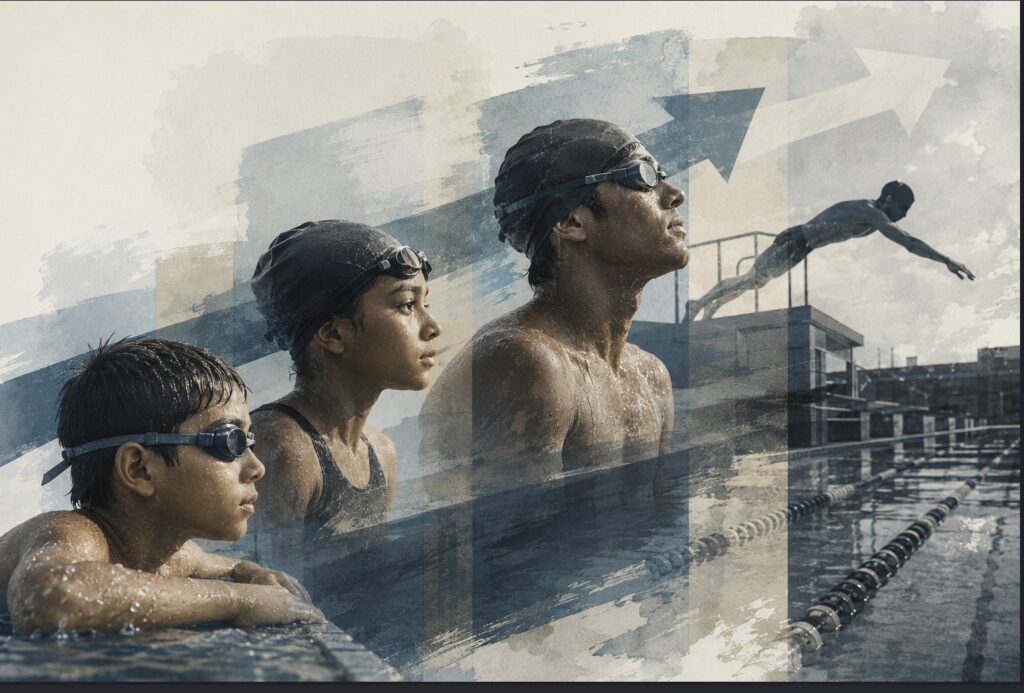
When the Swimming Federation of India restructured national championship age groups in May — clean two-year bands, 11–12 and 13–14 at sub-junior, 15–16 and 17–18 at junior — it was framed, correctly, as competition reform. Cleaner brackets, fairer racing, and a structure that finally maps onto World Aquatics’ 14–18 Junior World Championships window.

What wasn’t obvious at the time is that the same recalibration was happening one layer down, in the far less-read document that actually decides who gets tracked, mentored, and funded: the National Talent Pool Development Program’s annual time standards.
Line the two up and they tell the same story from opposite ends.
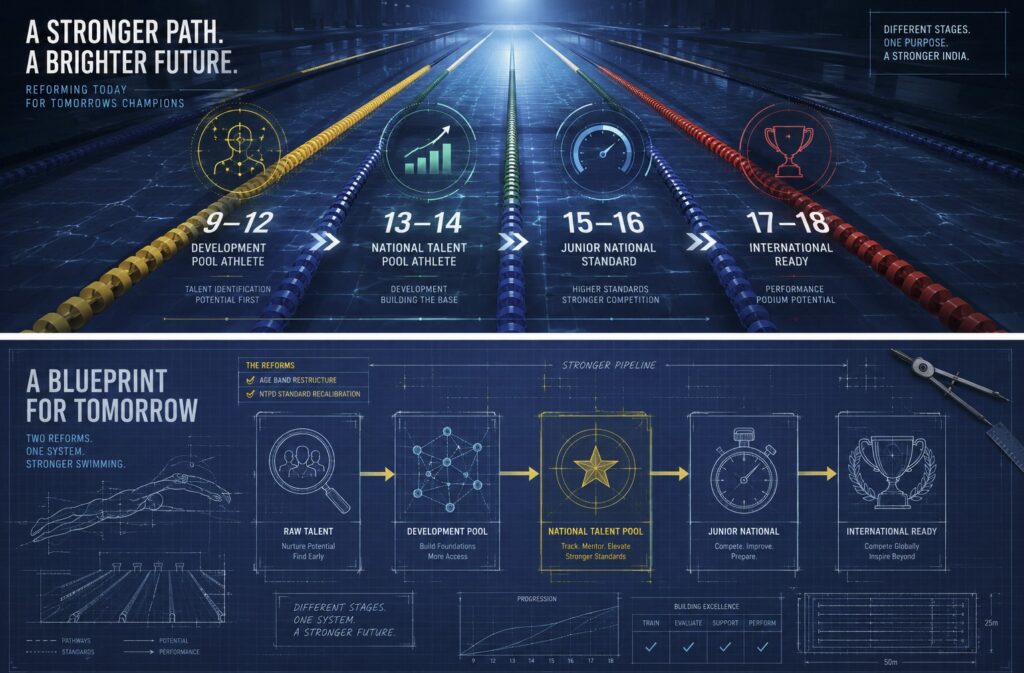
The pipeline moved with the brackets. In the 2025 edition of the NTPD document, National Talent Pool Athlete (NTPA) status — the tier that opens the door to training-log review, NPD mentoring, and eligibility for international exposure — kicked in at age 12. In the 2026 edition, that floor rises to 13. The Development Pool Athlete (DPA) band, meanwhile, moves from 10–14 down to 9–12, dropping its old requirement that a swimmer be a Sub-Junior/Junior National individual-event finalist to qualify.
Put simply: SFI has stopped asking 12-year-olds to perform like tracked elite prospects, and started asking them to be scouted as raw potential instead. That is precisely the philosophy the NTPD document itself argues for — a shift from “competition performance led” to “attributes led” criteria at the youngest ages — and it now has a structural home in the age-band reform to sit inside.
The standards tightened exactly where the brackets changed. Comparing the 2025 and 2026 NTPA cut-offs event by event, the senior standards (16 and up) are untouched — not a hundredth of a second different. The movement is concentrated almost entirely in the 13–15 age range, the same band the May reform carved out as its new sub-junior/junior dividing line:
- Girls’ 14yr 200m back: 2:40.0 → 2:30.54 (9.46 seconds faster)
- Girls’ 14yr 100m free: 66.23 → 61.89 (4.34 seconds faster)
- Girls’ 13yr 200m back: 2:43.4 → 2:35.92 (7.48 seconds faster)
- Boys’ 15yr 200m back: 2:15.5 → 2:11.99 (3.51 seconds faster)
- Boys’ 15yr 100m free: 56.92 → 55.74 (1.18 seconds faster)
That’s not a routine annual adjustment. That’s SFI raising the bar specifically for the swimmers who are about to be regrouped into tighter, more internationally-aligned competitive bands — which makes sense only if the two reforms were designed together, even if they were published as two unrelated documents months apart.
Read together, the logic holds up. A pipeline that used to ask a talented 12-year-old to prove themselves against elite-track standards, then threw that same swimmer into a national bracket alongside 14- and 15-year-olds, was arguably manufacturing exactly the kind of early-bloom, early-burnout pattern the NTPD document spends its opening pages diagnosing. Delaying the NTPA floor to 13, loosening the DPA entry criteria, and tightening standards only inside the newly-drawn 13–15 competitive band is a coherent, LTAD-consistent response to that diagnosis — not two federations working at cross purposes, but one federation working the problem from both ends at once.
What’s still worth asking SFI directly. A few things don’t fully add up yet, and are worth a straight question rather than a guess:
- The 2025 document included a 12-year-old NTPA table with a softer “Possible Director’s Choice” standard — effectively a discretionary on-ramp for promising-but-not-quite-there swimmers. That entire tier is absent from the 2026 document. Was it deliberately retired now that DPA covers age 9–12, or does it still exist in practice and simply wasn’t reprinted?
- The boys’ 13-year 200m fly standard moved from 2:33.1 to 2:44.99 — nearly 12 seconds slower, running against every other movement in the document. SwimmingDrive has reached out to SFI and NPD Chris Martin to confirm whether that figure is intentional or a transcription carry-over, and will update this piece with their response.
- None of this closes the loop on TOPS. SFI can recommend NTPA swimmers for TOPS inclusion, but selection remains “solely discretion of Mission Olympic Cell of SAI” — so a better-designed pipeline still hands off, at its most consequential moment, to a body outside SFI’s control.
None of that undercuts the direction of travel. Taken together, the age-band reform and the NTPD recalibration read less like two separate bureaucratic updates and more like the first sign of a federation actually building a pipeline with a memory — one that connects what happens to a swimmer at 12 to what’s asked of them at 15, rather than treating each competition season as its own island. Whether it survives contact with the 2026–27 season, with coaches, parents, and a genuinely overstretched NPD office, is the part worth watching.