A New Lane for India’s Young Swimmers
The Swimming Federation of India's revised age groups are on the expected lines— and could quietly transform the country's aquatic talent pipeline.
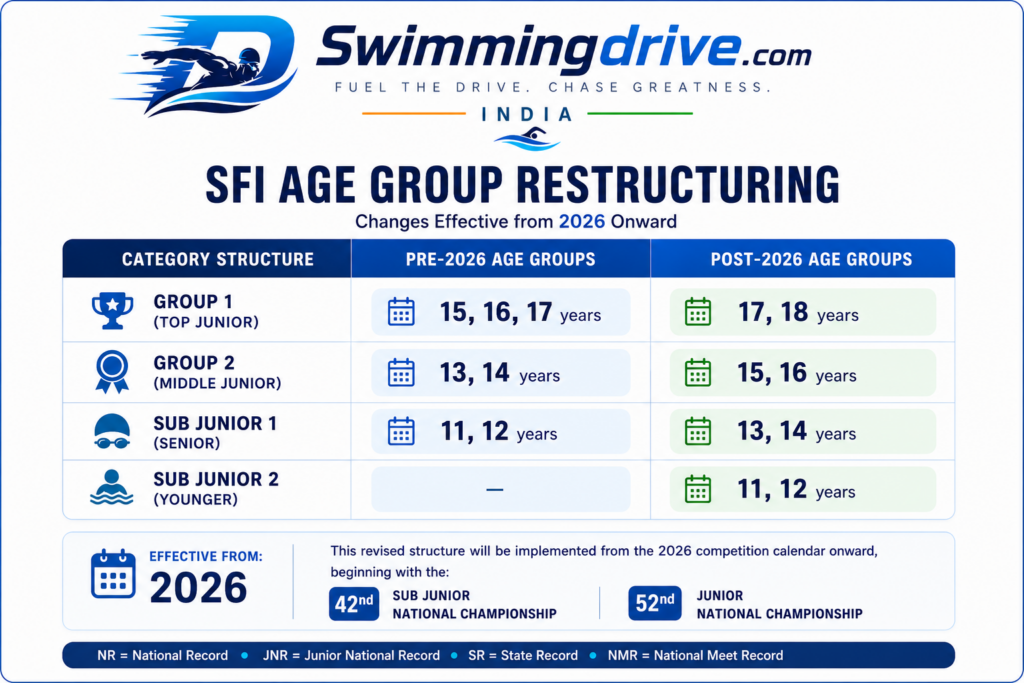
For quite many years, the national swimming championships in India have been a source of heartburn for many swimmers – due to the unwieldy age-groupings. Under the banner of the Junior National Championships, swimmers were banded in two broad categories – age 15,16,17 in Group 1 and 13,14 in Group 2. Younger swimmers competed in the Sub-Junior Groupings.
The impact of this was huge, a 15-year-old swimmer fresh from his or her successes in Group 2, will suddenly find him or her to be at an ‘disadvantage’ year, as the swimmer would have to compete with others who are up to 2 years older. This transition could be fairly disconcerting for swimmers – as they would lose motivation in their ‘disadvantage’ years and then gear up again in the ‘advantage’ years. In fact, this game of advantage and disadvantage had become quite deeply ingrained in the mentality of not only the swimmers, but also in the coaches and the parents. This was not only detrimental for the swimmers but also for swimming in general.
By, refining the age-groups into 2-year brackets, the Swimming Federation of India has not only simplified the pathway to national championships, but also made it more clinical and competitive. With swimmers competing in their respective 2-year bands, there will no longer be any excuses for advantage or disadvantage years.
The Swimming Federation of India has confirmed, through a circular dated 18 May 2026, that national championship age groups for swimming will be restructured into clean, two-year bands: 11–12 and 13–14 at sub-junior level, and 15–16 and 17–18 at junior level. The shift — backed by a majority vote of member units — is arguably the most consequential structural reform Indian competitive swimming has seen in a generation.
More swimmers, more chances
The most immediate effect of the new structure is simple: more swimmers get a genuine national-level opportunity. By splitting sub-juniors into two distinct brackets, the SFI has effectively doubled the competitive platforms available to younger athletes.
This matters enormously in a country where the pathway from state-level promise to national recognition is already unforgivingly narrow. Every additional rung on the development ladder is a reason for a young swimmer — and their family — to stay in the sport.
The structure also gives coaches something they rarely had before: a clear, predictable four-stage progression from age 11 all the way to senior competition. That kind of visibility allows for proper long-term planning, rather than the mad rush to peak a 12-year-old for a bracket that also contains 15-year-olds.
In step with the world
Internationally, the logic is even cleaner. World Aquatics runs its Junior World Championships for swimmers aged 14–18. Under the old SFI system, Indian athletes were being prepared in groups that didn’t map neatly onto that window. The new 15–16 and 17–18 junior bands align precisely, meaning India’s best young swimmers will arrive at international competition having been selected and trained in exactly the right competitive tier.
None of this is to say the transition is without concerns. As the changes have been announced just a few months before the national championships, swimmers currently mid-pathway will find themselves reclassified into a different group than the one they trained for. This could lead to a few hiccups in the days to come.
It is interesting to note that Australia, recently reintroduced the 13-year-old boys’ category at its Age Championships after data showed participation among 14–16-year-old boys had dropped sharply following an earlier structural change. The lesson travels.
In the end, one of the biggest issues of Indian swimming is the big dropout of swimmers in the 15-16 years bracket. As the years progress, there are lesser number of swimmers competing in the state and national level championships. This clearly hints that young swimmers are suffering a burnout. Globally, research supports delaying specialization until at least mid-adolescence, allowing for greater athletic development, more well-rounded swimmers, and reduced risk of injury and burnout. Specialization typically occurs between 14–16 for most swimmers. India’s new structure — with a clear 13–14 sub-junior band before the junior pathway — creates a more natural gateway to specialization, rather than thrusting 13/14 -year-olds into competition against 15-year-olds.
The reform is directionally right and internationally aligned. The two-year band structure is cleaner, fairer, and consistent with LTAD principles. The alignment with World Aquatics’ junior age windows is a genuine tactical win.
Now, looking that this shift in conjunction with the National Talent Pool Development initiative of SFI, the age-group change makes great sense. What the SFI has done is give Indian swimming a framework built for athletes, not administration. The two-year band model reflects how young bodies actually develop, reduces the arbitrary advantage of age within a cohort, and maps the country’s best juniors onto a pathway that connects, for the first time, directly to the international stage.